
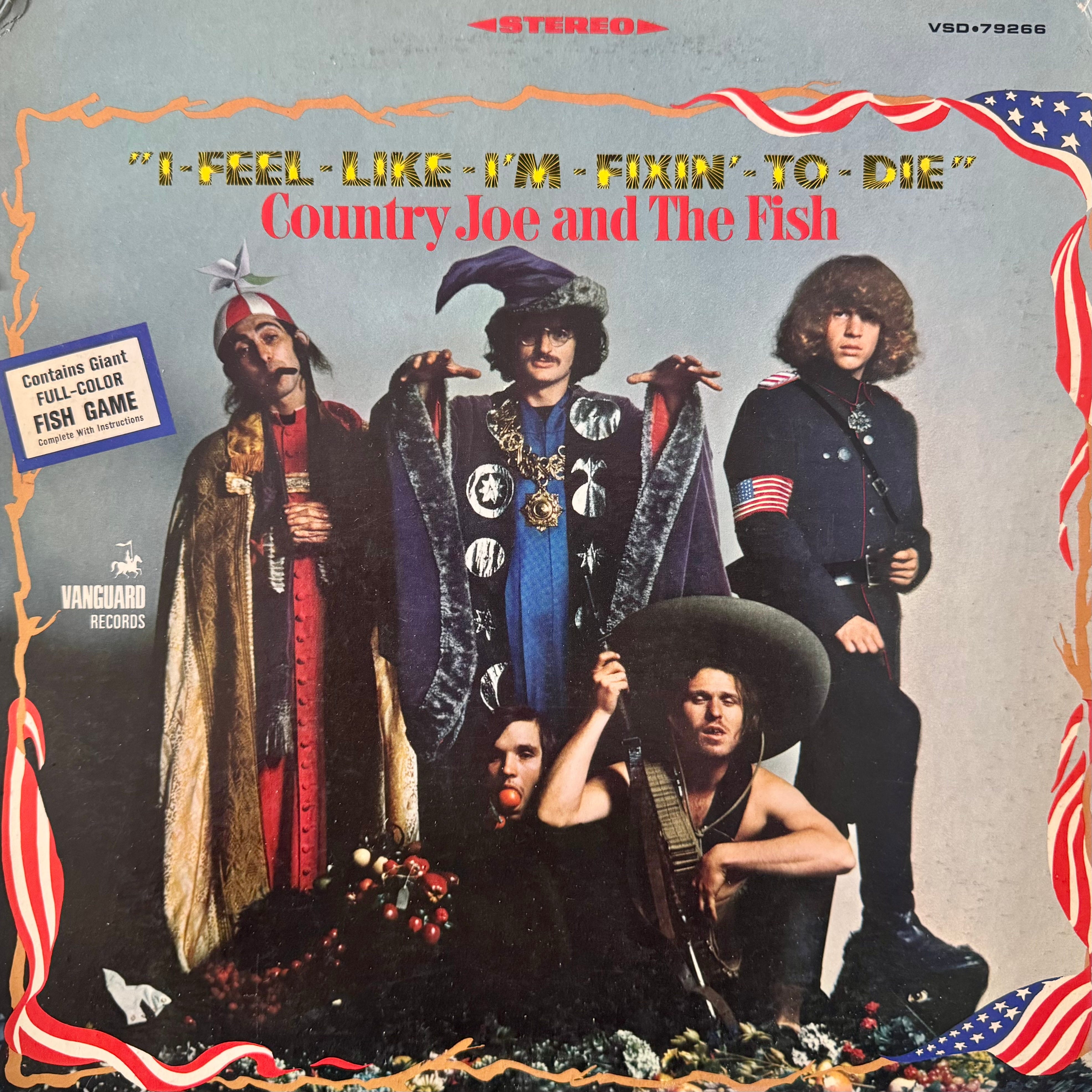
I am very sad, though not surprised, to see that Country Joe McDonald has passed away at the age of 84 in his home zone, Berkeley, California. Country Joe & The Fish were major heroes of mine when I was 15, and key figures in the counterculture. To me and my schoolmates, Joe epitomised the psychedelic warrior, freaky yet politicised.
In the crucible of 1967 California, his band were peers of the Jefferson Airplane and the Grateful Dead. Over in Britain, we read about them in the underground press and listened to their expensively imported records with great devotion, eyes clenched shut so we could see the landscapes their music laid out in our minds. Joe and the Fish were right at the epicentre of the seismic shift in consciousness that emanated from San Francisco. They were at the Human Be-In in Golden Gate Park that January, at Monterey Pop that summer, and key figures at Woodstock a couple of years later.
Joe’s lyrics were dreamy, ironic and satirical by turns. He never seemed to get carried off into the vapours of the mind for too long, but he obviously liked to visit. The Fish music was inventive and visual, evoking the synesthesia of sound and vision that characterises the best psychedelic music.
Teenage me assumed that the musicians who backed Country Joe were known collectively as “The Fish”, but it turned out that “The Fish” was simply the nickname of the lead guitarist, Barry Melton.
Barry became my first guitar idol. In my very earliest experiments with electric guitar, some school friends and I had an imaginary band called The Sunday Joint. We managed one rehearsal on amps and guitars that mysteriously materialised in a vault below a 14th-century cloister. My friend Caruso remarked:
“OK, Robyn, you’re great at doing a Barry Melton impression, but can’t you play a bit more like Eric Clapton?”
To this day, the answer is no. Barry’s propellor guitar on “Section 43” from the first Country Joe & The Fish album remains a lift-off peak from the psych era for me. Whenever I hear it, it shoots through my head from ear to ear like a silver drill.
The cover of their second LP, I-Feel-Like-I’m-Fixin-To-Die was fabulous. Joe, Barry, keyboard player David Cohen, bassist Bruce Barthol, and drummer Chicken Hirsch posed with theatrical elan in a bizarre hybrid of military, religious, and mystical costumes that caught my imagination in a big way. They were framed in a tableau of fruit and vegetables. I thought this picture was far better than the Beatles’ Sgt. Pepper’s Lonely Hearts Club Band cover, and I even drew it in art class at school. Country Joe’s louche bandit look with stubble, bare torso and Mexican hat seemed terminally cool to me, parked as I was in a boarding school in the English Home Counties, five thousand miles from the Happenings in California.
The Sunday Joint spent most of our downtime from school activities perched in trees in the meadows below St Catherine’s Hill in Winchester, pretending that we were on album covers. Posing in the vegetation was fashionable for hip bands at the time. In my head, at least, I was being either Fish man David Cohen, with his arms in mystical superhero mode, conjuring away evil spirits, or Joe himself crouched with his hat, stubble and gun. It was odd to us twee Brits how even American hippies like Country Joe and David Crosby (on the cover of Dejà Vu) would pose for album photos with rifles. Still, America was known to be the Wild West…
In early I969, my friends and I were thrilled to learn that Country Joe and the Fish were going to play the Lyceum in London. Our permissive academic parents didn’t seem to mind us going to an all-nighter there. We all smoked too many cigarettes, pretending they had something stronger than tobacco in them. We sat on the floor cross-legged while the warm-up acts paraded before us: the inevitable Junior’s Eyes, a pre-metal power trio who were living proof that you no longer needed to write proper songs to get on the bill; acoustic solo artist Roy Harper, who unleashed a 20-minute epic “McGoohan’s Blues: (which contained some great sections, to be fair) and announced half-way through: “I’ve broken a string, but it doesn’t matter”; the prog band Yes, who even then were glacial and perfect; and then, finally at around 4am - Country Joe and…some Fish. Barry Melton was still there, thankfully, but David, Chicken and Bruce were gone, replaced by other hairy men. Who played fine, but they weren’t David, Chicken or Bruce. Bummer.
Through the haze of other people’s dope smoke, we witnessed Joe, Barry & co. play some old favourites and some unfamiliar material. It was fine, but it was not magical. Joe’s voice wasn’t in great shape, and his electric guitar playing was fairly rudimentary. At one point, Barry sang a number I’d never heard before, called “Great Balls of Fire”. It was some years before I discovered Jerry Lee Lewis and learned the origin of that song.
To us, seeing Joe, Barry, and the gang going through the motions was just part of the whole late 1960s climb-down from the ecstatic peak of 1967. It was becoming clear that, once they walked out of their album covers, musicians were just people, who could play unspectacular gigs any time. We filed out into the March dawn hungry for egg-and-chips and a good snooze wherever we could find one.
Time passed, the decades rolled by, my friends and I went our separate ways, and Country Joe & the Fish, along with hippie acts like The Incredible String Band and Donovan, became part of history. I listened to their records occasionally just to time-travel. What I loved at 15 didn’t always carry into my older life with its flavour intact. All the while, Country Joe McDonald (minus the Fish) continued to tour, make albums, and exist at a lower-profile level in the musical eco-system: he was a folk-radical legend.
Meanwhile I, too, became a musician and appeared on album covers of my own, though sadly never in trees or on a carpet of fruit. In 1984, I returned to the Lyceum, at R.E.M.’s invitation, to see them in action for the first time. I didn’t recognise anything from 1969 that evening.
The decades continued to roll by, and in 2006 I finally met up with Barry Melton at a festival in La Rochelle, on the coast of France, where we were both performing. By now he had been a lawyer for many years and was with his wife, Barbara. Barry didn’t mention Country Joe at all, so I didn’t ask, but it seemed like they were happily out of touch with each other. I didn’t like to bother him with my ancient idolatry - he and Barbara just seemed like nice people to share cheese with. I did get to play on stage with him, which was fun. We were both part of a Beatles’ song finale, of which some grainy footage remains.
Eleven years later, in June 2017, I found myself once again seeing Country Joe performing live onstage. He was 76 years old at this point: looking good but struggling to play the guitar because of arthritis. His voice, however, was in better shape than it had been 48 years earlier. He had a band of younger musicians backing him as they played through the whole of that amazing first Fish album, Electric Music For The Mind And Body.
Watching Joe in his short-sleeved shirt singing these hallowed songs to a sparse crowd at the Great American Music Hall in San Francisco felt sad and dislocating. All that time gone, all that life lived, all that history he was part of - just to play to a few dozen people in a venue that I myself had played many times to larger crowds. He was Country Joe McDonald, dammit - didn’t that entitle him to a bigger audience?
But I guess he was a local act, and so the locals took him for granted. Or maybe it was just a badly-promoted gig. I decided not to regale him at the merch stand afterwards with tales of when I’d first seen him, instead I strode out into the Tenderloin dusk and away to my hotel off Union Square.
Not long after that, Country Joe played his official farewell gig at The Chapel, also in San Francisco, and then retired gracefully from music. I regret now not telling him how much he and his compadres meant to me, but - would that have meant anything to him? We’ll never know. But I do know a lot of us mature groovers appreciate what he did, the consciousness he represented, and the music he made.
Thank you, Joe.
Thanks for the lovely eulogy. They were indeed a great band and those records contain a lot of treasures unknown to those who haven't plumbed their depths. I just got an original pressing of the second LP on vinyl last month, complete with hippie board game still inside! Great fun.
Funny, isn't it - I think in general people like it when others express appreciation for their creative work. But maybe it depends on your point of view. I've always thought of it as a way to give back some of the good energy and erred on the side of saying something. Thankfully, I've had far fewer encounters with the sullen Dylans of the world who could care less and more priceless memories of the Bowies, Doc Watsons, and Townes Van Zandts who seemed quite touched and were incredibly gracious. But I chickened out of a few too - Bill Monroe, Steve Cropper. Anyway, here's hoping Country Joe knew he was appreciated for all his great grooves. 🙏
What a nice tribute. I just heard this morning that Country Joe had died. I'm pretty sure I have the LP you have pictured, though it's been years since I've listened to it. I was really into that 1960s San Francisco scene in my teenage years, and wanted to write a book about it, but I finally threw away all my notes years ago.